

Organoid platforms must show where their assays are fit to decide.

At a glance
Organoid platforms are no longer evaluated only by how closely they resemble human tissue. The harder question is where an assay is actually fit to inform a decision.
A new 7 May 2026 review on human organoids for drug discovery reinforces both sides of the opportunity: organoids are increasingly relevant as human biology-based NAMs, but reliability, scalability, assay robustness, throughput, and standardization still determine whether results can travel beyond the originating laboratory.
For senior teams, the practical implication is clear. Do not lead with the broad claim that an organoid model is more human relevant. Lead with the assay question, the evidence supporting that use, the comparator that makes performance interpretable, and the limits of the claim.
Why it matters now
The organoid field has moved from technical excitement into a harder phase: serious evaluation. Commercial teams, funders, technical diligence reviewers, regulatory scientists, advisory boards, and internal governance groups are not only asking whether organoids are innovative. They are asking what an assay can inform, compared with what, how reproducibly, and with what residual uncertainty.
That is why the most valuable organoid strategy is often narrower than the technology deserves. It uses fewer claims, clearer decision limits, stronger traceability, and a clear account of where the model adds information compared with a 2D assay, an animal model, clinical reference data, or an incumbent workflow.
The regulatory context points in the same direction, but it needs careful handling. FDA's March 2026 draft guidance on NAMs is non-binding, explicitly draft, non-method-specific, and not a drug-discovery application guide. It should not be turned into acceptance language for organoids.
What the evidence supports
The evidence does not support a simple story of organoids are ready or organoids are not ready. It supports a more useful conclusion: organoids are increasingly relevant for selected disease-modeling, drug-discovery, and toxicity-testing questions, but only when the assay role is narrow enough to be evaluated.
1. Organoids are part of the mainstream NAM discussion
FDA public materials list organoids, spheroids, organ-on-chip systems, in silico models, and other non-animal approaches as examples of NAMs. Category inclusion, however, does not imply validation, maturity, suitability, or acceptance for any specific decision.
2. Technical constraints are strategic constraints
Reliability, reproducibility, scalability, assay robustness, throughput, and standardization affect what claims a platform can support. A model may be excellent for mechanistic exploration and still be underprepared for screening, comparative toxicity, patient-stratification hypotheses, or regulatory-facing evidence packages.
3. Interpretability depends on the decision and comparator
Evidence for target biology exploration is not the same as evidence for lead optimization, safety-risk triage, batch comparability, or patient-stratification hypotheses. Each use case requires different controls, comparators, endpoints, and uncertainty language.
Strategic implications
A platform does not become validated in the abstract. It becomes fit, or not yet fit, for a defined assay role, comparator set, evidence threshold, and stakeholder question.
In pharma diligence, investor technical review, grant evaluation, regulatory-meeting preparation, or platform partnership, biological detail is not enough. The buyer or evaluator needs to know whether the organoid platform improves a decision they already care about: selecting compounds, deprioritizing liabilities, explaining mechanism, supporting a translational package, or reducing uncertainty before a milestone.
The comparison matters as much as the model.
A practical assay-readiness lens
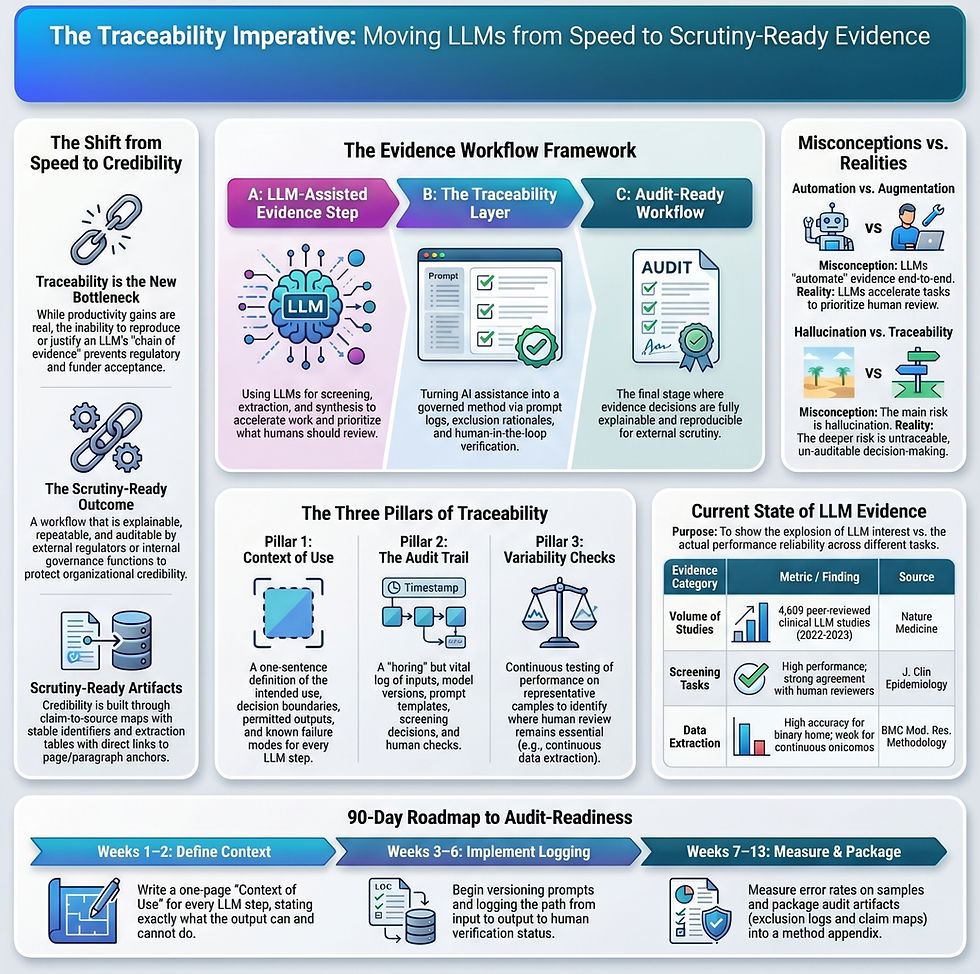
Assay role: define the practical job first. Is the organoid model informing discovery, prioritization, toxicity-risk triage, mechanism, responder biology, or regulatory-science discussion?
Confidence in the result: separate biological plausibility from confidence in the assay result. Show reproducibility, endpoint relevance, sample handling, analytical performance, robustness, and known failure modes.
Benchmark comparison: make the comparison explicit. Is the claim being made against animal data, 2D cell systems, historical clinical observations, a standard toxicity screen, or the current internal workflow?
Regulatory interpretability: avoid implying that inclusion in NAM discussions creates acceptance. Explain how the evidence could be interpreted, what uncertainty remains, and what additional validation or qualification route may be relevant.
Adoption logic and stakeholder narrative: identify who changes workflow if the model performs, then translate the evidence differently for pharma, funders, investors, regulators, and consortia.
Risks, caveats, and open questions
The main risk is overclaiming. Organoids may support more human-relevant evidence in selected contexts, but that does not mean they replace animal studies, clinical evidence, or regulatory requirements by default. It also does not mean one organoid platform can serve all drug-discovery or safety-assessment decisions.
The second risk is under-specification. A vague claim such as our organoid model predicts human response is difficult to defend. A narrower claim, linked to a defined endpoint, comparator, intended use, and uncertainty limit, is easier to test, improve, and discuss with reviewers.

A 90-day readiness roadmap
Month 1: define the priority assay role and the suitability claim, including the decision, stakeholder, endpoint, comparator, workflow alternative, and claim that is not yet defensible.
Month 2: build a confidence and benchmark matrix. Separate what is established, what is plausible, what is assumed, and what remains untested. Add reproducibility, robustness, scalability, endpoint relevance, and comparator evidence where available.
Month 3: create a reviewer-facing claim map. For each claim, identify the source, confidence level, caveat, and next evidence action. A formal Context of Use can sit inside that package, but it should not substitute for the evidence work around it.
Executive takeaways
Organoid platforms have moved beyond novelty in selected biomedical and drug-discovery contexts. The strategic task now is to define exactly where the assay is fit to decide, which comparator makes the result meaningful, and what confidence is strong enough to support the claim.
For FRESCI's audience, the better question is not is the model advanced? It is what can this assay help a serious reviewer decide? Teams that answer that question early will be better prepared for the next high-stakes review.
FAQ
What does assay suitability mean for an organoid model? Assay suitability means the model, endpoint, controls, comparator, reproducibility evidence, and uncertainty limits are clear enough for a specific stakeholder question.
Does FDA's NAM guidance mean organoids are accepted for drug development? No. FDA's 2026 NAM guidance is draft, non-binding, non-method-specific, and not a drug-discovery application guide. It does not confer acceptance for any specific organoid platform or use case.
What evidence makes an organoid platform adoption-ready? That depends on the use case, but typically includes biological relevance, technical characterization, reproducibility, robustness, comparator logic, endpoint relevance, uncertainty analysis, and clear limits on the claim.
FRESCI note
FRESCI helps NAM and biomedical-platform teams turn complex scientific evidence into regulator-aware, commercially credible strategy. For organoid teams, that can start with a focused review of assay role, benchmark logic, reproducibility evidence, and claim limits ahead of diligence, funding review, or regulatory-science discussion.
References
1. Wittich, A., Krieg, K., Gribbon, P., Metzger, J. J., Prigione, A., & Pless, O. (2026). Human organoids: Fit for drug discovery? Stem Cell Reports. Available online 7 May 2026.
2. Organoids in drug development: from predictive models to regulatory integration. Drug Discovery Today. 2026.
3. U.S. FDA. (2026). General Considerations for the Use of New Approach Methodologies in Drug Development draft guidance.
4. U.S. FDA. (2026). Office of Translational Sciences 2025 Annual Report.
5. ISSCR. (2026). Human Biology, Better Medicines: Advancing iPSC-Based Models for Discovery and Development.

Comments